
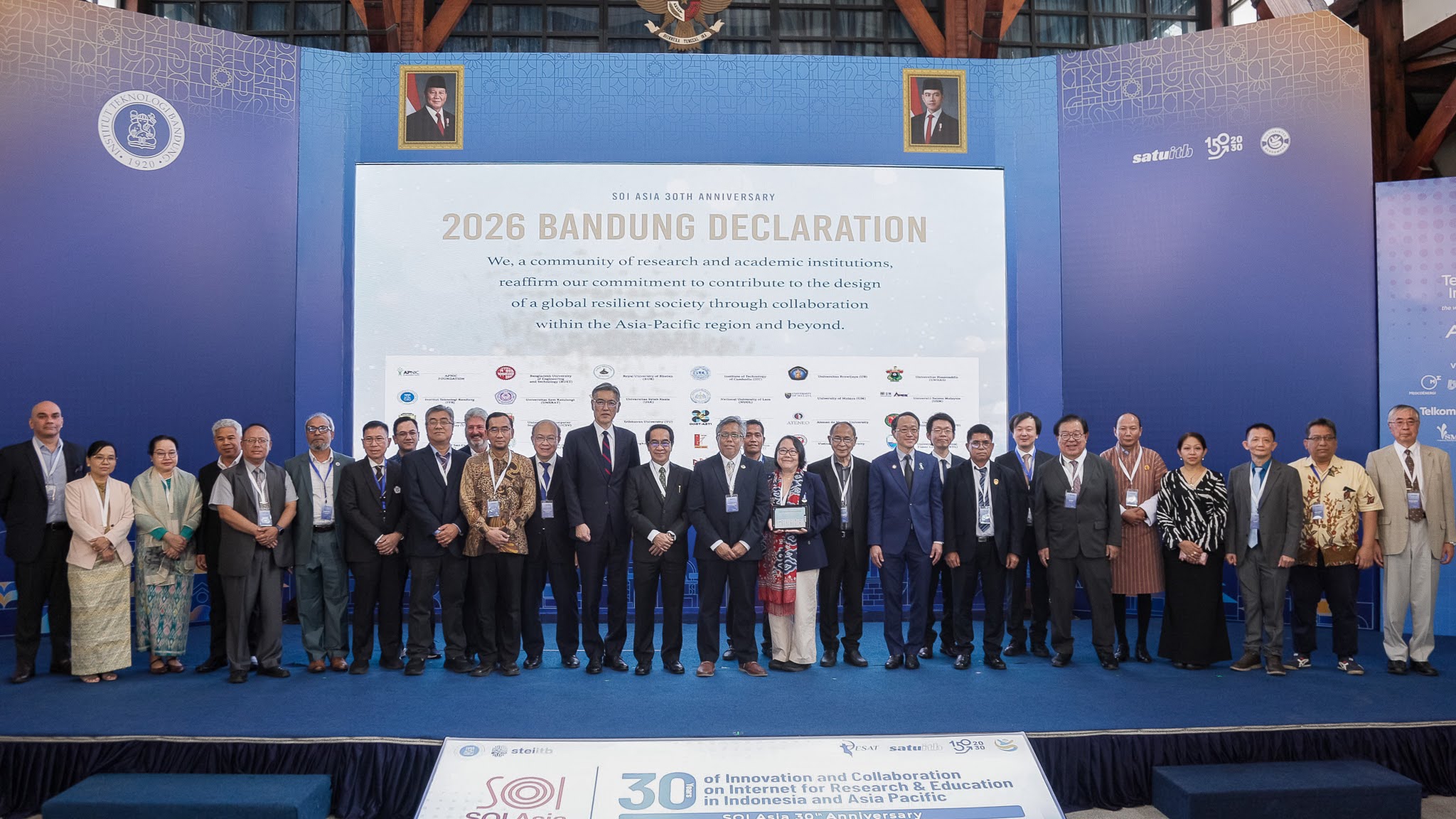
Feature image caption: Signatories of the 2026 Bandung Declaration gather on stage during the SOI Asia 30th Anniversary Conference in Bandung, Indonesia.
Three short declarations, adopted in the same city at ten-year intervals, offer three snapshots of the evolution of the SOI Asia community.
In 2006, the emphasis was on partnerships and friendships. In 2016, it moved towards Research and Education Networks and their interconnections for knowledge and wisdom. In 2026, 28 signatories came together around a shared commitment: contributing to the design of a global resilient society through collaboration.
The three Bandung Declarations do not tell the complete story of SOI Asia’s 30 years. But read together, they show how the community’s sense of purpose has expanded — from strengthening relationships, to connecting research and education institutions, to considering what those relationships, connections and capabilities can contribute to society.
They also show what has remained constant: collaboration.
2006: Strengthening partnerships and friendships
The first Bandung Declaration was adopted on 11 October 2006, at a time when the community was celebrating ten years of AI³ and five years of SOI Asia.
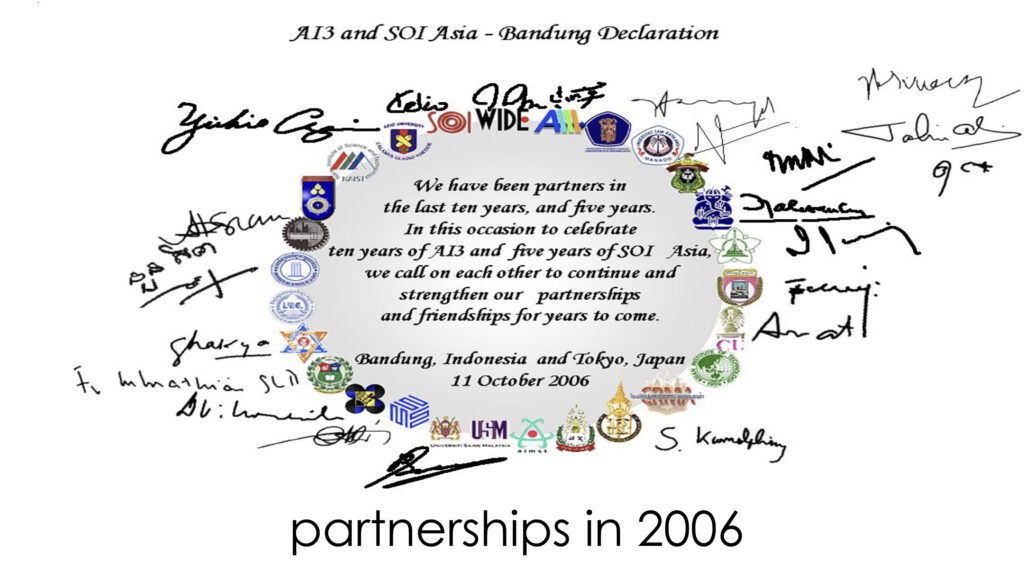
Its focus was straightforward. Reflecting on the relationships established during those early years, partners called on each other to “continue and strengthen our partnerships and friendships for ten years to come.”
The choice of words reflected how the community had developed. AI³ had initially brought universities and research institutions together around the challenge of building Internet connectivity across Asia. SOI Asia then used that infrastructure to share educational opportunities across institutions and borders.
But something else had developed alongside the technology: relationships.
This was consistent with the principles articulated in SOI Asia’s 2003 Mission Statement, which placed Equal Partnership and Sharing Knowledge at the center of the initiative. Institutions were not simply endpoints connected to a network. They were partners contributing knowledge, resources and experience to a shared educational environment.
The 2006 Declaration captured that foundation in particularly human terms: partnerships and friendships were something the community wanted to preserve and strengthen for its next decade.
2016: Connecting infrastructure for knowledge and wisdom
When the community returned to Bandung ten years later, the environment around it had changed.
Internet connectivity had expanded significantly across Asia, but research and education institutions increasingly required networks capable of supporting advanced research, collaboration and the exchange of large amounts of data. Research and Education Networks (RENs) had become an important part of that environment.
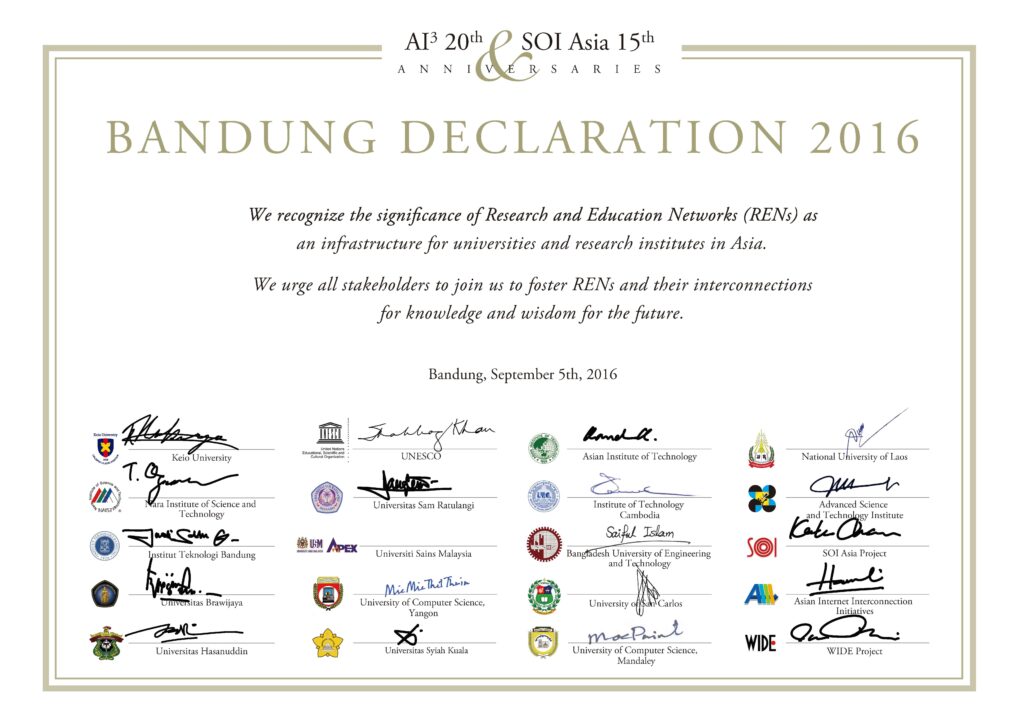
The 2016 Bandung Declaration therefore recognized “the significance of Research and Education Networks (RENs) as an infrastructure for universities and research institutes in Asia.” It called on stakeholders to foster RENs and their interconnections “for knowledge and wisdom for the future.”
The declaration placed infrastructure at the center, but infrastructure was not the destination. Its purpose was to enable universities and research institutions to connect, collaborate and create and share knowledge.
The emphasis had therefore expanded from the relationships highlighted in 2006 towards the connections that could support those relationships at a larger scale.
During this period, SOI Asia itself was also evolving beyond its original distance education activities. Education, research and regional collaboration increasingly intersected, while the community continued to explore how shared infrastructure and knowledge could address challenges across countries and institutions.
From being connected to being resilient
The following decade brought another shift.
By 2020, the COVID-19 pandemic was disrupting education, research and everyday life around the world. For the SOI Asia community, it also demonstrated the value of capabilities and relationships developed through years of distributed collaboration.
Partners were already accustomed to working and learning across borders using the Internet. SOI Asia meetings moved online, institutions shared information and experience, and activities continued in new forms.
The experience contributed to a broader discussion within SOI Asia about resilience — not simply as resistance to disruption, but as the capacity to adapt, recover, learn and transform when circumstances change.
This thinking increasingly shaped the community’s direction. SOI Asia began describing its mission around designing a resilient future society in the Asia Pacific, bringing education, research, platforms and infrastructure together within a collaborative community.
By the time the community approached its 30th anniversary, the question had therefore become broader than how institutions could remain connected. It was also about what a connected and collaborative research and education community could contribute to society.
2026: From collaboration to contribution
The third Bandung Declaration reflects that change in perspective from its opening words.
“We, a community of research and academic institutions…”
Thirty years after the first connections among partner universities, the signatories explicitly describe themselves as a community.
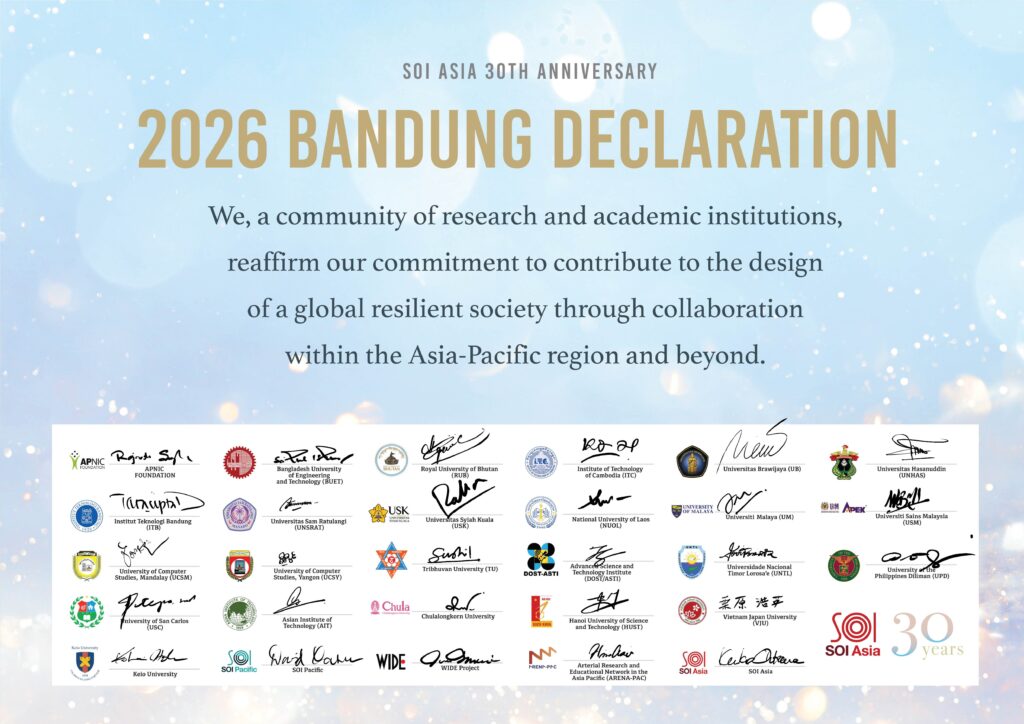
The declaration then turns outward:
“We, a community of research and academic institutions, reaffirm our commitment to contribute to the design of a global resilient society through collaboration within the Asia-Pacific region and beyond.”
Twenty-eight signatories endorsed the Declaration during the SOI Asia 30th Anniversary Conference in Bandung on 2 September 2026.
Several words in the declaration connect the past with what comes next.
“Reaffirm” signals continuity. Collaboration is not a new principle introduced in 2026. It has been part of how the community has worked across institutions and borders throughout its history.
“Design” points towards a broader role for research and academic institutions. The aim is not simply to build a particular network, platform or solution, but to contribute knowledge, research, education and experience to thinking about what a resilient society should look like and how it can be realized.
And “beyond” extends the horizon. While collaboration within the Asia Pacific remains at the center of SOI Asia, the declaration recognizes that many of the challenges facing society extend beyond regional and institutional boundaries.
The scale of the commitment has changed. The relationships and connections remain, but the question is increasingly how they can be used to contribute.
Three declarations, one continuing journey
The three Bandung Declarations are remarkably concise. Together, however, they capture different moments in a much longer journey.
The 2006 Declaration is about relationships. Partnerships and friendships developed through the first years of AI³ and SOI Asia were to be continued and strengthened.
The 2016 Declaration is about connections. RENs and their interconnections could provide infrastructure through which research and education institutions create and exchange knowledge and wisdom for the future.
The 2026 Declaration is about contribution. The community now looks at how collaboration within the Asia Pacific and beyond can contribute to the design of a global resilient society.
One declaration does not replace the one before it.
Relationships make collaboration possible. Connections allow people, knowledge and resources to move across institutions and borders. Education and research build capabilities and generate new knowledge. Together, these provide a foundation from which institutions and communities can contribute to wider challenges.
In this sense, the three declarations show both transformation and continuity.
SOI Asia has moved from an era in which connecting universities across Asia was itself a major challenge to one in which connectivity is part of a much broader ecosystem of education, research and collaboration. The technologies have changed, activities have expanded, and new generations have joined.
But the belief that institutions can accomplish more by working together has remained.
Looking towards the next decade
Each Bandung Declaration has looked forward.
In 2006, partners committed to strengthening their relationships “for ten years to come.” In 2016, interconnected RENs were envisioned as infrastructure for “knowledge and wisdom for the future.” In 2026, the horizon extends further: towards a global resilient society.
The third Declaration is therefore both an anniversary milestone and a starting point.
It does not prescribe what the next ten years of SOI Asia will look like. Technologies will continue to change, new challenges will emerge, and the ways people learn, research and collaborate will evolve with them.
Instead, it establishes a direction: to carry forward 30 years of relationships, connections and shared experience, and use them to contribute to a resilient future — together.