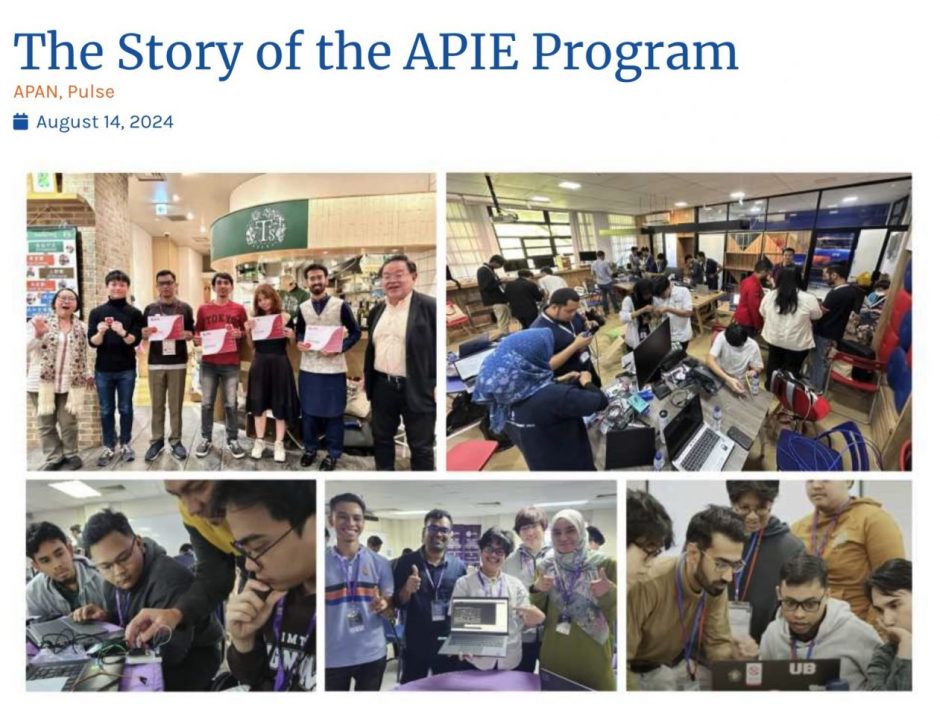
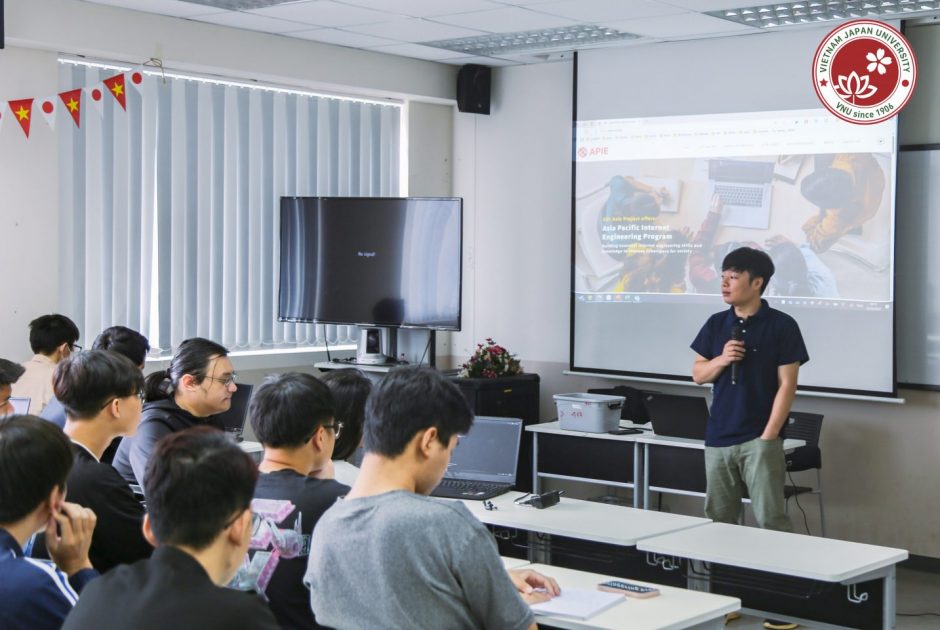
Since 2021, SOI Asia has offered the APIE (Asia Pacific Internet Engineer) program to partner universities across Asia to develop Internet talent. Recently, a part of this program has been adopted as regular formal course material at Vietnam-Japan University (VJU).
The online courses “Understanding the Internet” and “Operating the Internet” included in the APIE program have been utilized in the required course “Computer Networks and Communications” (instructor: Quang Trung Lu, lecturer) for 43 third-year of undergraduate students in the Computer Science and Engineering (BCSE) program at VJU, starting in October 2024.
Students who complete these courses will not only earn credits from VJU, but also receive digital certificates that conform to the Open Badges standard issued by SOI Asia on its digital certificate platform INXIGNIA. The digital badges provided through INXIGNIA can be attached when applying to various SOI Asia programs or used as proof of skills and learning history on business platforms such as LinkedIn.
The APIE program generally accepts students twice a year and consists of the following components.
- APIE Online: Self-paced learning through two online courses offered by Keio University on FutureLearn.
- Course #1 “Understanding the Internet” (4 weeks)
- Course #2 “Operating the Internet” (5 weeks)
- APIE e-Workshop: A series of six seminars and hands-on sessions held bi-weekly on Saturdays via Zoom. These sessions provide opportunities for reflection on learning and community building while progressing through the online courses.
- APIE Camp: A five-day camp-style program for students who completed the APIE Online and APIE e-Workshop. Hosted by partner universities in Asia, this camp brings together approximately 20-25 students from various Asian universities, including Keio, for collaborative learning.
- APIE Advanced Camp: A five-day residential program open to students who completed the APIE Camp. This camp, held mainly in Japan, gathers approximately 20-25 students from several Asian universities, including Keio, for further collaborative learning.
To date, over 1,400 students from 18 universities across 10 Asian countries have registered for the APIE program, resulting in more than 1,000 digital badges (certificates) being issued. Additionally, the “Understanding the Internet” course offered through APIE Online is available to the public worldwide, with approximately 1,200 students from 99 countries.
Students from VJU who completed APIE Online as part of a regular formal course can continue to participate in other courses, including in-person courses such as “APIE Camp” and “APIE Advanced Camp” by participating in the “APIE e-Workshop” mentioned above after the class period and continuing their study. These APIE courses are offered as extracurricular activities at JVU, providing students with practical skills and knowledge as well as opportunities to build a professional network with peers from SOI Asia partner universities in countries like Indonesia, Malaysia, and the Philippines, along with researchers and active network engineers in the Internet industry. This experience is also expected to offer valuable insights into future career paths.
SOI Asia is a platform for inter-university education and research cooperation, launched in 2001 led by Keio University. As of 2024, 29 universities and research institutions are participating in the APIE program. The APIE program, supported by the APNIC Foundation, began in 2021 as part of SOI Asia’s initiatives, in collaboration with partner organizations like the WIDE Project and AITAC (Advanced IT Architect Council), with a mission to nurture the next generation of Internet professionals.
Today, the development of Internet infrastructure technologies and network operations tends to attract less attention from young engineers compared to emerging technologies like smartphone applications, generative AI, blockchain, and quantum computing.
However, with approximately thirty percent of the global population still lacking Internet access, despite a worldwide penetration rate of around seventy percent1, there remains a strong demand for more engineers in the Internet sector. The APIE program aims to equip university students with knowledge of the Internet’s history, design philosophy, practical skills, and career pathway planning, fostering talent to support research and operations in the Internet field, primarily across the Asia-Pacific region.
Vietnam-Japan University was established in July 2014 as the seventh member university of Vietnam National University, Hanoi, under the initiative of the Japanese and Vietnamese governments. Its mission is to foster future leaders and professionals, promote sustainable development, and enhance knowledge transfer between Japan and Vietnam. With “Liberal Arts” and “Sustainability Science” as its educational philosophy, VJU currently offers a wide range of academic disciplines, focusing on interdisciplinary social sciences and advanced engineering and technology. Specifically, VJU offers eight graduate master’s programs (Area Studies, Business Administration, Public Policy, Global Leadership, Nanotechnology, Civil Engineering, Environmental Engineering, and Climate Change and Development) and six undergraduate programs (Japanese Studies, Computer Science and Engineering, Civil Engineering, Smart Agriculture and Sustainability, Food Technology and Health, Intelligent mechatronics and Japanese production). As of 2024, the university has approximately 1000 students and is steadily growing as a medium-sized comprehensive university that nurtures human resources to actively contribute within Vietnam and internationally.
(1) https://www.itu.int/itu-d/reports/statistics/facts-figures-2023/